How Our Brains Are Being Hacked – A Guide to Digital Traps
Why does it feel like everyone has gone mad on the internet?
We often feel that two completely separate worlds exist on the internet, especially on platforms like Facebook or TikTok. On one side, they say “black,” and on the other, “white”; the two camps not only fail to understand one another, but it also seems as if they aren’t even living on the same planet.
Numerous studies are being conducted on this subject, and based on these, we can state that it is not that people have suddenly become less intelligent. Rather, professional methods, sophisticated technology, and algorithms are exploiting the weaknesses of our brain functions. In this article, we will use simple examples to show how we are enclosed in bubbles, why we believe lies, and how professional propagandists deceive us.
The Filter Bubble and the Echo Chamber
Many people conflate these two concepts, but there is an important distinction between them: one is something we receive, while the other is something we create.
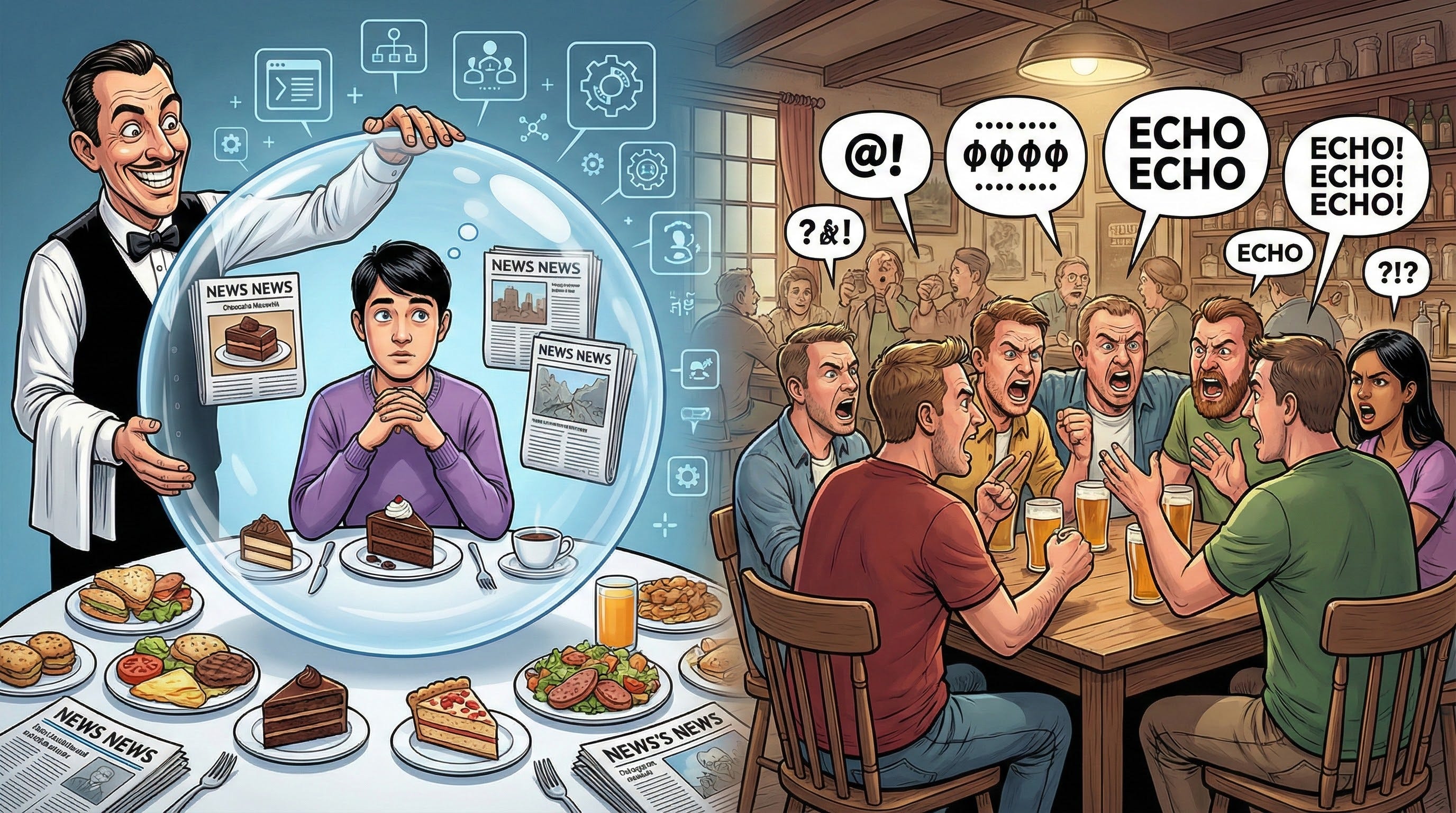
The Filter Bubble: The Overzealous Waiter
Imagine a waiter who is extremely attentive. He notices that you like chocolate ice cream, so the next time you visit, he only shows you the chocolate desserts on the menu. You think only these exist, even though there is strawberry cake as well—you just don’t see it.
Algorithms on the internet do exactly this. They observe what you click on, where you live, and who your friends are. Their goal is to keep you on the website for as long as possible, so they only show you things that will appeal to you.
If you like cat videos, that is all you will get. If you read news from a specific political party, the system hides the opposing side’s opinion from you. This is called a filter bubble: when the machine decides what you see on your behalf, and you don’t even notice that a part of the world has been blocked out.
The Echo Chamber: The Pub Regulars’ Table
The echo chamber is different. This is not built by the machine, but by us. It is like a table of regulars at a pub where we only allow those who agree with us to sit. If someone says something different, we boot them out, block them or unfollow them.
Here, the issue is not that we don’t see the other opinion, but that we don’t trust it. In an echo chamber, our own group’s opinion constantly echoes back and intensifies. If a hundred people around you say the sky is green, sooner or later you will believe it and look at anyone who says it is blue as if they are crazy.
The danger is that facts no longer matter here, only who is stating them. If “our guy” says it, it’s true; if the enemy says it, it’s a lie.
In short:
Filter Bubble: You don’t see the other side because the algorithm hides it.
Echo Chamber: You don’t believe the other side because you have locked yourself in among your own kind.
Why Do We Believe Fairy Tales?
Propaganda works because the human brain is lazy and loves comfort. Two main tricks are exploited against us.
The “Inner Lawyer” (Cognitive Dissonance)
Do you know the feeling when you know smoking is harmful, but you light up anyway and tell yourself: “Ah, my grandfather smoked too, and he still lived to be 90”? In psychology, this is called cognitive dissonance.
Our brain hates contradiction. If a politician we love does something bad, it is a painful feeling—a disappointment. To avoid this pain, our brain activates the “inner lawyer,” who begins to manufacture excuses. “Surely it wasn’t him,” “Others are even worse,” “The media is just blowing it up.”
Propagandists play on this: they put comfortable lies in our mouths so we can soothe our conscience.
“I Told You So!” (Confirmation Bias)
Everyone loves being right. If you see a news story about a group you hate doing something bad, you immediately believe it without verification because it confirms your opinion. If you read the same news about your own group, you immediately start to suspect that it must be fake news.
This is called confirmation bias. The “like-dispensing machine” on Facebook seeks precisely this dopamine hit, this feeling of joy:
See, I was right!
The Art of the Professional Con
How do professionals exploit these weaknesses?
Anger = Money
The goal of social media platforms (Facebook, YouTube, TikTok) is not truth, but to keep you in front of the screen so you see advertisements. Research shows that anger and outrage keep people there the best.
If you see a cute dog, you smile and scroll on. But if you see something that outrages you, you comment, share, and argue. The algorithm sees that this content interests people and serves it up to even more users. This is how inflammatory fake news spreads like wildfire, while the boring truth barely reaches anyone.
The Firehose of Falsehood
In the past, propaganda meant making you believe one big lie. Today, Russian-style propaganda works differently: they don’t push one story, but a thousand.
Imagine a plane crashes. The propaganda doesn’t just say “we didn’t shoot it down.” Instead, it throws ten versions at once:
The pilot was drunk.
It was blown up on the ground.
There was no plane, only dummies were on board.
The Americans shot it down.
This is called the Firehose of Falsehood. The goal is not for you to believe one specific version, but for you to get confused. In the end, you wave it off: “We’ll never know the truth, everyone lies.” That is exactly the goal: apathy and the destruction of trust.
The “Pick a Card” Trick (Reflexive Control)
This method was developed by the Soviets, but it is still used today. The essence is to manipulate you in such a way that you believe you made the decision.
It is like when a magician says, “Pick a card!” but holds the deck in a way that ensures you can only pick the one he wants. In politics, this looks like intentionally leaking information that the opponent or the voter will react to predictably.
For example, they make you believe that “there will be war if you don’t vote for us.” You vote for them out of fear, believing this was your free choice for the sake of peace, when in reality, you followed a pre-written script.
The Situation in Hungary: Two Realities in One Country
This phenomenon is particularly strong in Hungary. According to research, the country has essentially split in two.
Rural Echo Chambers: In many small settlements, people primarily get information from government-aligned media (TV2, county newspapers). Here, they see a reality where the source of all trouble is an external enemy (Brussels, war, migrants), and the government is the sole protector.
Online Bubbles: On the internet, everyone locks themselves into their own Facebook groups. If a piece of news doesn’t fit into their worldview, it is simply labeled “fake news.”
This is why the same event (e.g., high inflation) is seen by one side as the government’s fault, and by the other side as “war inflation” caused by evil external forces.
How Can We Defend Ourselves?
The bad news: Fact-checking—when we are told retrospectively that something is not true—is unfortunately not effective enough. The lie is faster, and by the time the truth comes out, people have either forgotten it or do not believe the rebuttal.
The good news: There is a new method called “prebunking” (pre-emptive debunking or “inoculation”). It works similarly to a medical vaccine. If you are shown in advance how they want to deceive you, you will recognize the trick later.
So, if you know that shocking headlines (e.g., This is what they are hiding from us!) are usually scams, the next time you see one, you won’t click on it out of anger. Instead, the alarm bell will go off in your head: “Hey, this is just playing on my rage!”
What Can You Do Starting Tomorrow Morning?
Count to ten! If a post triggers anger or fear in you, do not share it immediately. That is exactly their goal.
Look outside the bubble! Sometimes read what the other side is writing as well. You don’t have to agree with them, but know what they think.
Check the source! If a news story has no author or comes from a website you have never heard of (e.g., “everythingisasecret[.]com”), be suspicious.
The propagandists’ greatest weapon is not the lie itself, but our inattention and emotions. If we know their tricks, we have already half-won.


